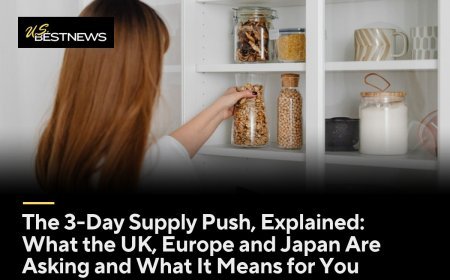




















The 3-Day Supply Push, Explained: What the UK, Europe and Japan Are Asking and What It Means for You
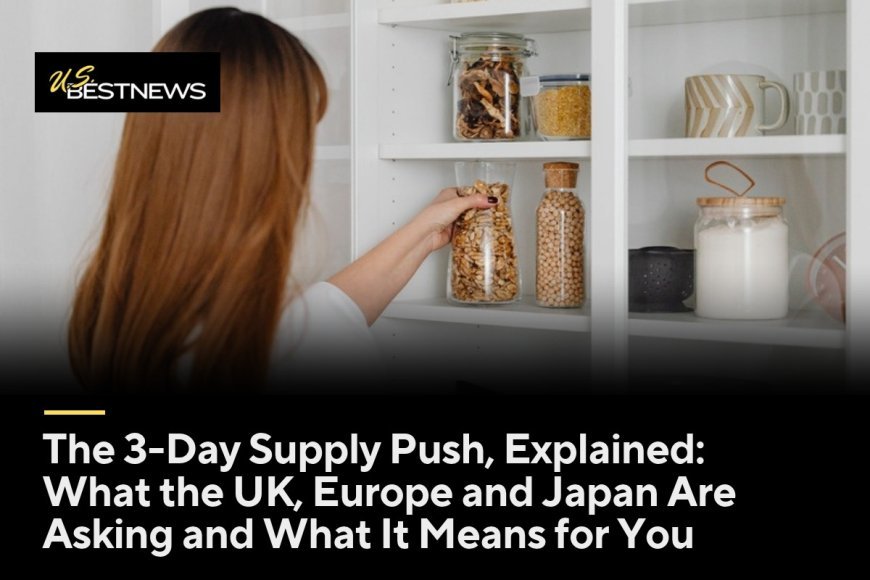
If your social feeds have filled up with talk of a "3-day supply" this week, you are not imagining it. Within a few days, the British government launched a public campaign asking households to be ready to manage for 72 hours, and Japan's disaster minister said he plans to ask the whole country to keep food, water and toilet supplies on hand. Online, some posts have treated that timing as a sign that something big is coming.
The official messages say otherwise. They describe routine, long-term readiness, the kind of advice emergency agencies have given for years. Here is what has actually been announced, what is genuinely new, and what it means for households in the United States.
What the UK actually announced
On October 22, 2026, the UK Cabinet Office published updated household advice under a new campaign called Be Ready. The government describes it as the first stage of a three-year effort to help people prepare for events such as severe weather, which can occasionally knock out power, water, phones and the internet.
The core message is that households able to do so should be ready to look after themselves for three days if everyday services are disrupted. The checklist includes bottled water, non-perishable food, a flashlight, a battery or wind-up radio, a charged power bank, a first-aid kit, essential medicines and some cash in small bills and coins.
The water guidance is specific: at least 3 liters of drinking water per person per day, which is roughly three-quarters of a gallon. The government's own statement says much of the advice has not changed since it began publishing resilience guidance in May 2024. What is new is the branding, the simple checklist format and the national publicity.
What the EU and Japan are saying
The European Union's version is older. In March 2025, the European Commission published its Preparedness Union Strategy, which included a plan to develop guidelines helping member countries reach self-sufficiency of at least 72 hours in the early stage of a major disruption. Several European countries, including France, Ireland and the Netherlands, already run their own three-day messaging, and the UK said its campaign brings it in line with those peers.
Japan's step is still ahead. According to reporting by Japanese broadcaster FNN and others, Disaster Management Minister Goshi Hosono said he plans to issue an "urgent request" on November 2, the day Japan's new disaster management agency launches. He said households should keep at least three days, and ideally a week, of food, water and toilet supplies. The formal text had not been published at the time of writing.
Japan's focus is natural disasters, especially large earthquakes and a possible eruption of Mount Fuji. Its guidance on stockpiling at least three days of supplies is not new either. Japanese authorities have recommended it for years.
Canada and the US have said this for years
Canada's government has long told residents to be prepared to take care of themselves for at least 72 hours in an emergency. Its checklist calls for at least 2 liters of water per person per day, plus an additional 2 liters per person per day for cooking and cleaning if possible.
In the United States, Ready.gov, run by FEMA, says that after an emergency you may need to survive on your own for several days. It recommends one gallon of water per person per day for several days, for drinking and sanitation, along with a several-day supply of non-perishable food. The CDC recommends storing at least 1 gallon per person per day for three days, and a two-week supply if possible.
The American Red Cross goes further for supplies kept at home. It recommends one gallon of water per person per day, with a three-day supply for evacuation and a two-week supply for home. In other words, the advice now making headlines abroad is close to what US agencies have recommended all along.
What is and is not new
What is new is mostly timing and attention. The UK campaign launched with national publicity, Japan's announcement followed within days, and the combination made the three-day message feel like a coordinated alarm. On social media, some posts speculated about cyberattacks or planned outages. None of the official announcements describe a specific threat or a new imminent event.
The UK government links its campaign to recent storms and wildfires and it asks eligible people to sign up for the Priority Services Register, which utilities use to support vulnerable customers during outages. The European strategy covers a wide range of hazards, from floods and wildfires to cyber incidents, and is framed as long-term planning. Japan's request is tied to earthquake and volcanic risk and to the launch of a new agency.
What has not changed is the basic logic. In the first days of a serious disruption, help may be slow to reach everyone. Households that can cover their own basics free up responders for those who cannot. That idea has been at the center of preparedness advice in many countries for decades.
Why the numbers differ from country to country
Readers comparing checklists may notice that the water figures do not match. The UK asks for at least 3 liters per person per day for drinking alone. Canada's basic figure is 2 liters per person per day, with another 2 liters suggested for cooking and cleaning. US agencies use one gallon per person per day, which is about 3.8 liters and is meant to cover drinking and basic sanitation.
The differences come from how each agency defines the purpose of the water, not from any disagreement about safety. For US households, the simplest approach is to follow the US guidance: one gallon per person per day, and more for hot climates, pregnant women, people who are sick and pets, as the CDC notes.
The length of time also varies. Three days is the common minimum. The Red Cross and CDC encourage two weeks of supplies at home when possible, and Japan's minister said he would like people to aim for a week.
What US households should take from it
The practical takeaway is modest. You do not need to rush to the store, and you do not need special survival products. You need enough water, food, light, information and basic medical supplies to get through a few days if the power, water or stores are unavailable, which can happen during ordinary storms.
Start by checking what you already have. Many households have canned food, a flashlight and some bottled water without thinking of it as an emergency kit. Fill the gaps gradually during normal shopping trips, as both the UK and US agencies suggest.
Keep a little cash at home, write down important phone numbers on paper, and make sure prescriptions will not run out at a bad moment. Ready.gov also recommends a battery-powered or hand-crank radio, ideally a NOAA Weather Radio, so you can get official information if cell service fails.
Reading the headlines calmly
When preparedness advice goes viral, it helps to go back to the source. Government announcements usually explain why they are issuing advice and what they are asking people to do. In this case, the UK, EU, Japanese and Canadian messages all describe readiness for everyday emergencies, not a warning about a specific event.
Be skeptical of posts that claim insider knowledge or urge you to buy particular products quickly. Panic buying can create shortages for neighbors and lead you to spend money on things you will not use.
Three days of supplies is a reasonable, low-cost goal that protects your household during the storms, outages and water problems that happen every year. The international attention is a useful reminder to check your own shelves this weekend, calmly and on your own budget.
What's Your Reaction?
 Like
0
 Dislike
0
 Love
0
 Funny
0
 Angry
0
 Sad
0
 Wow
0