


























Medicare and Holiday Travel: Does Your Coverage Work Out of State or Abroad?
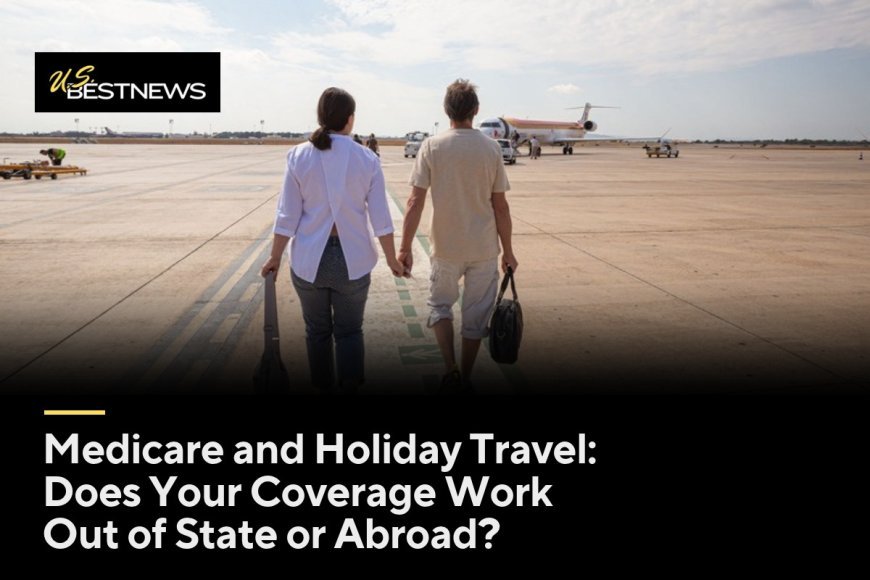
Is your Medicare card good in another state over Thanksgiving, or on a cruise or a trip to see grandchildren overseas in December? The answer depends almost entirely on which kind of Medicare coverage you have. Many retirees find out the details only after something goes wrong, which is the worst time to learn them.
Before you pack, take ten minutes to check your plan type and read the travel rules that apply to it. Here is what Medicare.gov says about each option, and the practical steps to take before you leave home.
Original Medicare travels well inside the US
If you have Original Medicare, meaning Part A and Part B, your coverage generally works anywhere in the United States. You can see any doctor or hospital in any state that accepts Medicare, and the same deductibles and coinsurance apply as at home.
That makes Original Medicare one of the simplest options for domestic travel. Whether you are visiting family across the country or spending a few weeks somewhere warmer, you do not need permission or a referral to get covered care from a provider that takes Medicare.
The main practical step is to bring your red, white and blue Medicare card, along with any supplement or drug plan cards. If a provider asks whether they accept Medicare, they mean whether they accept Medicare assignment, so it is fine to ask before non-emergency care.
Medicare Advantage depends on the network
Medicare Advantage plans are run by private insurers, and many use provider networks, such as HMOs or PPOs. According to Medicare.gov, Medicare Advantage plans cover emergency and urgently needed care anywhere in the United States, even outside the plan's network.
Routine care is a different story. In an HMO, non-emergency care outside the network is often not covered at all. PPOs usually cover out-of-network care, but at a higher cost. Some plans offer travel or visitor programs that let members use providers in other areas for a limited time.
Because rules vary by plan, call the member services number on your card before you travel. Ask how the plan handles urgent care, follow-up visits and prescriptions while you are away, and whether there is a nurse line or telehealth service you can use.
Outside the US, coverage is limited
Medicare.gov is clear on this point: in most cases, Original Medicare does not cover health care or supplies you get outside the United States. There are a few narrow exceptions, generally involving situations near the border or on a ship close to US waters, but most travelers should assume they are not covered abroad.
Some Medicare Advantage plans include coverage for emergency care outside the country. This is a plan-specific benefit, not a guarantee, so check your Evidence of Coverage or ask the plan directly.
Part D drug plans generally do not cover prescriptions bought outside the United States. Fill what you need before you leave, and keep medicines in their original labeled containers.
Medigap can help with emergencies abroad
If you have a Medicare Supplement Insurance, or Medigap, policy, check its letter. According to Medicare.gov, Medigap Plans C, D, F, G, M and N include foreign travel emergency coverage.
That benefit pays 80 percent of the billed charges for certain medically necessary emergency care outside the United States after you meet a $250 deductible for the year. It applies only if the care begins during the first 60 days of a trip, and it has a lifetime limit of $50,000.
Plans A, B, K and L do not include this benefit. Plans C and F are no longer available to people who became eligible for Medicare on or after January 1, 2020, though people who already have them can keep them.
When travel insurance makes sense
Because Medicare coverage abroad is limited, many retirees buy a travel medical insurance policy for international trips. These policies can cover emergency care and, in some cases, medical evacuation, which can be very expensive without coverage.
Read the policy carefully before buying. Look at the coverage limits, what counts as a pre-existing condition, any age restrictions and whether the policy pays providers directly or reimburses you later.
For cruises, check whether the cruise line's medical center bills separately and whether your policy covers care on the ship and in foreign ports. Coverage at sea can differ from coverage on land.
Prescriptions on the road
Running out of medicine on a trip is one of the most common travel problems for retirees. Before you leave, count how many doses you need, add a few extra days for delays and ask your pharmacy whether you can get an early refill. Policies on early refills vary by plan.
For domestic travel, many large pharmacy chains can transfer a prescription to a location in another state. If your Part D plan uses a preferred network, check which pharmacies near your destination are included.
Pack medicines in your carry-on, not checked luggage. Keep a written list of each drug, the dose and your prescribing doctor's contact information, and bring copies of prescriptions for international trips.
A pre-trip checklist
Start by confirming your coverage type. If you are not sure whether you have Original Medicare, Medicare Advantage or a Medigap policy, check your cards or log in to your Medicare account.
Next, call your plan or plans. Ask about emergency care, urgent care and prescriptions where you are going. Write down the phone numbers and keep them with you, along with copies of your cards.
Finally, decide whether you need extra protection. For trips abroad, compare travel medical insurance options. For long stays in another state with a Medicare Advantage HMO, ask about visitor programs or consider how you would handle routine care.
If something happens while you are away
In a true emergency, get care first and sort out billing later. Call 911 in the United States. Abroad, know the local emergency number before you go and keep it in your phone.
Keep every receipt, bill and medical record from care you receive while traveling. If you need to file a claim with Medigap, a travel insurer or a Medicare Advantage plan, you will need detailed documentation.
Contact your plan as soon as you reasonably can after emergency care. Some plans have notification requirements, and early contact can make follow-up care and claims smoother.
Keep your cards and numbers handy
Before you leave, put your Medicare card, any Medicare Advantage or Medigap card and your Part D card in your wallet. Save your plan's customer service number and nurse line in your phone, and write them on paper as a backup in case your phone battery dies.
A word on open enrollment
Medicare open enrollment runs from October 15 to December 7 each year. If you travel often, this is a good time to think about how well your current coverage fits your plans.
Someone who spends winters in another state may find that Original Medicare with a Medigap plan, or a Medicare Advantage plan with a broad network or visitor program, fits better than a local HMO. Switching Medigap policies outside certain protected periods may involve medical underwriting in many states, so get details before making changes.
Free, unbiased help is available through your State Health Insurance Assistance Program, known as SHIP. Counselors can walk you through how different options handle travel.
What's Your Reaction?
 Like
0
 Dislike
0
 Love
0
 Funny
0
 Angry
0
 Sad
0
 Wow
0