



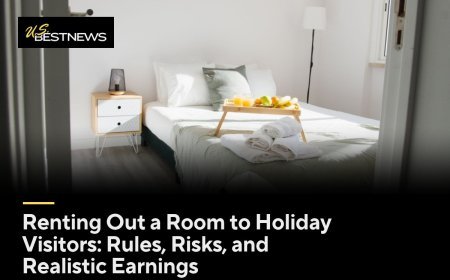





















Renting Out a Room to Holiday Visitors: Rules, Risks, and Realistic Earnings
Holiday travel brings a wave of visitors looking for places to stay, and some homeowners wonder whether their spare bedroom could earn a little extra in November and December. It can, but the math, the rules and the risks deserve a close look before you list it.
This guide covers the tax rule that makes short holiday rentals unusual, the local and insurance questions to settle first and how to estimate what you might actually earn.
The 14-day tax rule
The IRS has a special rule for homes that are rented out for only a short time. According to IRS Topic 415 and Publication 527, if you use a dwelling unit as a home and rent it out for fewer than 15 days during the year, you do not report the rental income and you do not deduct rental expenses.
This is often called the 14-day rule. For a homeowner renting a room for a few holiday weeks, it can mean the income is not taxable at the federal level, as long as the total rental days for the year stay under 15.
If you rent for 15 days or more, you generally must report the income, and you may be able to deduct some expenses. The rules for dividing expenses between personal and rental use can get complicated, so consider talking to a tax professional if you plan to rent more often.
Check local rules first
Many cities and counties regulate short-term rentals. Some require permits or registration, some limit how many days a year you can rent and some ban short-term rentals in certain neighborhoods.
Check your city or county website for short-term rental rules. Look for terms such as short-term rental, transient occupancy or home sharing. Some places also require you to collect and pay local lodging taxes.
Even if the IRS does not tax the income under the 14-day rule, local lodging taxes may still apply. Some rental platforms collect these taxes automatically, but not everywhere.
Read your lease or HOA rules
If you rent your home, check your lease. Many leases prohibit subletting or renting rooms to others without the landlord's permission. Breaking those terms could put your housing at risk.
If you own a home in a community with a homeowners association, check the HOA rules. Some associations ban short-term rentals or limit them.
Condo owners should also review building rules. Some buildings restrict guests or require registration.
Insurance gaps to know about
Standard homeowners and renters insurance policies may not cover short-term rental activity. If a guest is injured or damages your property, your policy might not pay.
Call your insurer before you list. Ask whether your policy covers renting a room, and whether you need an endorsement or separate policy. Some insurers offer home-sharing coverage for an additional cost.
Some rental platforms provide host protection programs, but these have limits and are not a replacement for insurance. Read the terms carefully.
Estimating realistic earnings
To estimate what you might earn, look at similar listings in your area on rental platforms. Note the nightly prices for private rooms during the dates you plan to rent.
Then subtract costs. Platform service fees, cleaning, extra utilities, toiletries, linens and any local taxes or permit fees can reduce your take-home amount. If you hire a cleaner, include that cost.
Be realistic about how many nights you will actually book. Holiday demand can be strong in some areas and weak in others. A room near family-heavy suburbs, a university or a popular destination may book more easily than one in a quiet area.
Preparing the room
Guests expect a clean, comfortable space. Fresh linens, towels, good lighting and a place to put luggage go a long way. A lock on the bedroom door can help guests feel secure.
Think about shared spaces. Decide which areas guests can use, such as the kitchen or living room, and set clear house rules about quiet hours, smoking and pets.
Make sure smoke and carbon monoxide alarms work, and keep a fire extinguisher handy. Some local rules require these for rental hosts.
Safety and privacy for your household
Renting a room means a stranger is staying in your home. Use platforms that verify guest identities and review guest ratings before accepting a booking.
Lock away valuables, important documents and medications. Consider whether you are comfortable with guests when children or older relatives are in the home.
Trust your instincts. If a booking request feels off, you can decline it.
Other ways to host holiday visitors
If short-term rentals are not allowed or do not feel right, there are other ways to earn from holiday travel. Some families rent their homes to visiting relatives of neighbors or coworkers through word of mouth.
Renting a parking space or driveway near a popular event or airport can be another option, depending on local rules.
If you have family visiting, you may simply save money by hosting instead of paying for hotels. That is not income, but it can make a real difference to the family budget.
Taxes beyond the federal rule
The 14-day rule applies to federal income tax. State income tax rules may differ, so check your state's guidance. Some states follow the federal rule and others do not.
Rental platforms may issue tax forms, such as Form 1099-K, if your payments meet certain thresholds. Receiving a form does not necessarily mean the income is taxable, but keep records that show the number of days you rented so you can explain your situation if needed.
Set clear house rules and communicate
Before guests arrive, share house rules, check-in and check-out times and Wi-Fi details. Clear communication prevents misunderstandings.
Decide how you will handle late arrivals, extra guests and problems such as noise. Many platforms let you list rules on your listing page, and guests agree to them when they book.
Keep communication on the platform. Many platforms warn against taking payments or conversations off-platform, which can remove protections and open the door to scams.
Watch out for rental scams
Hosts can be targeted by scams too. Be cautious of guests who ask to pay outside the platform, send overpayments and request refunds, or ask for your personal information. Report suspicious requests to the platform.
Two quick scenarios
Consider a homeowner who rents a spare room for eight nights around Thanksgiving and five nights around New Year's. That is 13 days for the year, which falls under the IRS threshold of fewer than 15 days, so under Topic 415 the income would not be reported and the expenses would not be deducted. The homeowner still needs to follow local rules and may owe local lodging taxes.
Now consider a homeowner who rents the same room for 20 nights over the season. Because the rental days reach 15 or more, the income generally must be reported, and the expense rules in Publication 527 come into play. Keeping a simple calendar of rented nights is the easiest way to know which side of the line you are on.
Common mistakes new hosts make
New hosts often underestimate cleaning time and supplies, skip the insurance call or forget to check local permit rules until after a booking. Others accept the first request without reading the guest's profile. Settling these points before you list saves most of the stress.
Is it worth it?
For some homeowners, renting a room for a few holiday weeks can bring in useful extra cash with little tax impact. For others, local rules, insurance costs and the hassle make it not worth the effort.
Start by checking the rules, calling your insurer and running the numbers. If everything lines up, start small, perhaps with a few nights, and see how it goes.
Keep careful records of the dates you rent and what you earn. If you stay under 15 days, the IRS rule may keep things simple. If you go over, you will be ready for tax time.
What's Your Reaction?
 Like
0
 Dislike
0
 Love
0
 Funny
0
 Angry
0
 Sad
0
 Wow
0